

About Bangladesh
Bangladesh is a South Asian country bordered by India to the north, east and west and the Bay of Bengal and Myanmar to the south and southeast. Bangladesh emerged as a country in 1971 after a nine-month war of independence against Pakistani rule. The region had been under Muslim rule for five and a half centuries and came under British rule in 1757. During British rule, it was part of the British Indian provinces of Bengal and Assam. In August 1947, it gained independence from British rule along with the rest of India and formed a part of Pakistan known as East Pakistan.
Bangladesh achieved independence in 1971 after decades of political marginalization, cultural oppression and a brutal nine-month war of liberation, which ended with the surrender of Pakistan on December 16, 1971. The struggle officially began with the declaration of independence on March 26, 1971 and ended with the birth of a sovereign nation after immense sacrifices. And we have achieved a country of peace, a country of freedom, Bangladesh of independence
History of Bangladesh
Dhaka is the capital of Bangladesh, known for its exciting history and rich culture. Known worldwide as the city of mosques, muslins, rickshaws and natural green beauty, it has been attracting travelers from far and wide for ages. According to recorded history, it was founded by Buddhists in the 3rd century, later dominated by Hindus before falling under Muslim Mughal rule in the 13th century.
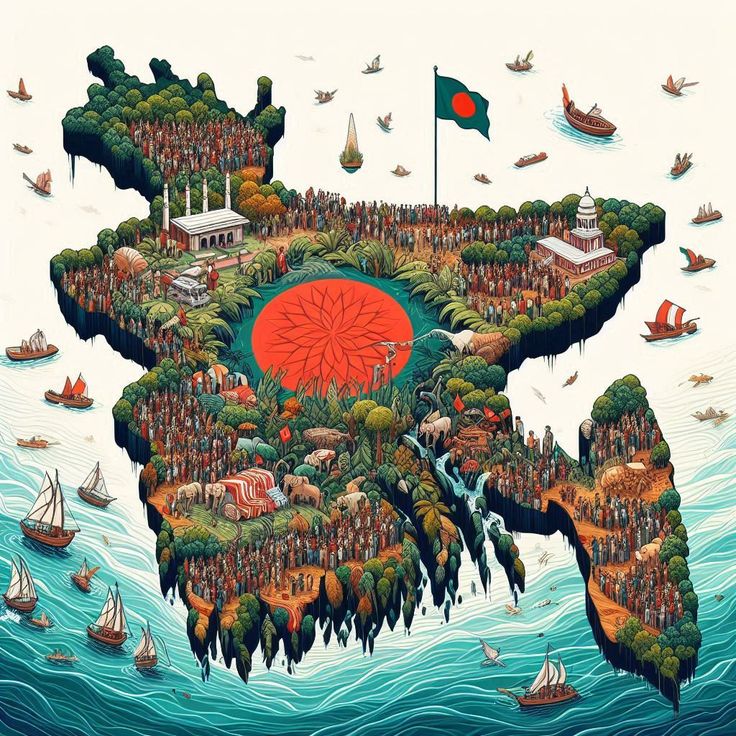

This was Dhaka’s golden age when it became a great Mughal trading port and finally became the capital of Bengal in 1608 by Subedar Islam Khan. Before 1608, Dhaka’s old name was Jahangir Nagar, and it became the capital in 1610. In the 16th century, Dhaka was the 11th largest capital in the world. The Mughals transformed Dhaka into a magnificent city, with residences for sultans, dozens of ornate mosques, covered markets, gardens and a huge fort to protect it from pirates and foreign powers. In the 17th century, the Portuguese, Dutch, British, French, Armenians and Greeks all came here for trade. They fought each other for the favor of the Mughals. But it was the British who finally won and took control of Dhaka in 1765. The British dominated until 1947 and then it was taken over by Pakistan. We got independence from them in 1971. And the result of that war is the land of independence, the green and lush Bangladesh.
Religion
Bangladesh is a country of religious freedom, harmony and tolerance. People of all castes and religions live here in perfect harmony. The percentage distribution of the population by religion is as follows: Muslim 88%, Hindu 10%, Christian, Buddhist and others 2%. Festivals: The biggest religious festival of Muslims is Eid-ul-Fitr (at the end of the fasting month of Ramadan). Eid-ul-Adha
Jatiya Sangsad
The building (Bangla name for the building) is one of the most visited landmarks in Bangladesh, a masterpiece of architecture and a true achievement for the country. It was designed by the world-renowned American architect and Yale University professor Louis I. Khan. Originally commissioned by the Pakistanis when Bangladesh was known as East Pakistan after the partition of the Indian subcontinent, its construction began as the second seat of the Jatiya Sangsad. Construction began in 1964, but was halted due to the Bangladesh War of Independence and was finally completed in 1982.
In this parliament, all kinds of MPs, ministers, including the Prime Minister, elected by the people of Bangladesh, meet in the parliament of Bangladesh and take any kind of decision for the people and everything that is needed to run Bangladesh is taken from this parliament building. In a word, this parliament building is the greatest and one of the national buildings of my Bangladesh.
The Bangladesh National Museum
Bengali originally established on 20 March 1913, albeit under another name, and formally inaugurated on 7 August 1913, was accorded the status of the national museum of Bangladesh on 17 November 1983. It is located in Shahbag, Dhaka. The museum is well organized and displays have been housed in several departments like the department of ethnography and decorative art, department of history and classical art, department of natural history, and department of contemporary and world civilization. The museum also has a conservation laboratory.


